You have been obsessed with Reels. Your entire team is chasing them. Your budget is going into video production. And your engagement numbers are still flat.
Here is what nobody is telling you: while every brand on the planet is pouring energy into Reels, carousels are quietly dominating the engagement metrics that actually matter. And the ecommerce brands that figured this out early are pulling so far ahead that their competitors do not even understand why.
This is the complete Instagram carousel strategy 2026 playbook. By the end of this guide you will know exactly how to build carousels that stop the scroll, drive saves, generate comments, and move products off shelves. Not theory. Not vague advice. A step by step system you can implement today.
The Data Nobody Is Talking About: Why Carousels Are Winning in 2026
Before we get into tactics, you need to understand why this matters. Because if you are still treating carousels as an afterthought, you are leaving serious engagement on the table.
Recent 2025 data reveals something that reshapes everything about how smart brands approach Instagram: carousel posts deliver an average engagement rate of 10 percent. Single image posts sit at 7 percent. Reels? 6 percent. The format everyone told you to prioritize is actually performing the worst for engagement.
It gets more interesting. Compared to single photos, an Instagram carousel achieves 1.4 times wider reach and 3.1 times higher engagement rates. Carousels also generate 95 percent higher save rates than any other format and contribute to a 27 percent increase in session duration compared to single image posts.
Why does session duration matter? Because Instagram’s business model runs on keeping people on the platform as long as possible so they see more ads. When your content extends sessions, Instagram rewards you with more distribution. Carousels are engineering gold for the algorithm.
And here is the feature that almost nobody talks about: when a follower does not swipe through to the end of your carousel, Instagram treats the unseen slides as new content. The platform will show your carousel to that same person again, picking up from where they stopped. This means a single 10 slide carousel can get shown to the same person multiple times, each time counting as a fresh engagement opportunity. No other format on Instagram does this.
The shift is real. The data is clear. And the brands building their instagram carousel strategy 2026 around this reality are winning while everyone else argues about Reels.
Carousels vs Reels: Settling the Debate Once and For All
This is not an either or conversation. But you need to understand what each format actually does so you can use both correctly.
Reels reach people who have never heard of you. The Instagram algorithm pushes Reels to non-followers more aggressively than any other format. If you need new eyeballs, new followers, and top of funnel awareness, Reels are your growth engine. Average Reels get approximately 1.36 times more reach than carousel posts. That reach advantage is real and you should not ignore it.
Carousels engage the people who already know you. They are your relationship engine. They are how you turn followers into buyers. They generate saves, extended views, comments, and shares at a rate that Reels cannot match. For ecommerce brands with an existing audience, carousels are where the money lives.
The strategic breakdown looks like this:
For accounts under 10k followers: publish 2 to 3 Reels per week for reach and 1 high quality carousel per week for engagement. You need Reels right now because you need growth.
For accounts between 10k and 100k followers: publish 1 to 2 Reels per week and 2 to 3 carousels per week. You have enough of an audience to start maximizing engagement and conversions.
For accounts over 100k followers: 1 Reel per week to maintain algorithm relationship and 3 to 4 carousels per week as your core strategy. At this size carousels overtake Reels as your primary driver of results.
Use Reels to fill the top of your funnel. Use carousels to convert the audience already inside it. That is the framework every serious ecommerce brand needs to understand in 2026.
The Architecture of a High Performing Carousel: The 5 Pillar Framework
Creating a carousel that performs is not about randomly throwing slides together and hoping something lands. Every high performing carousel follows an underlying structure. Here is the exact framework broken into five pillars.
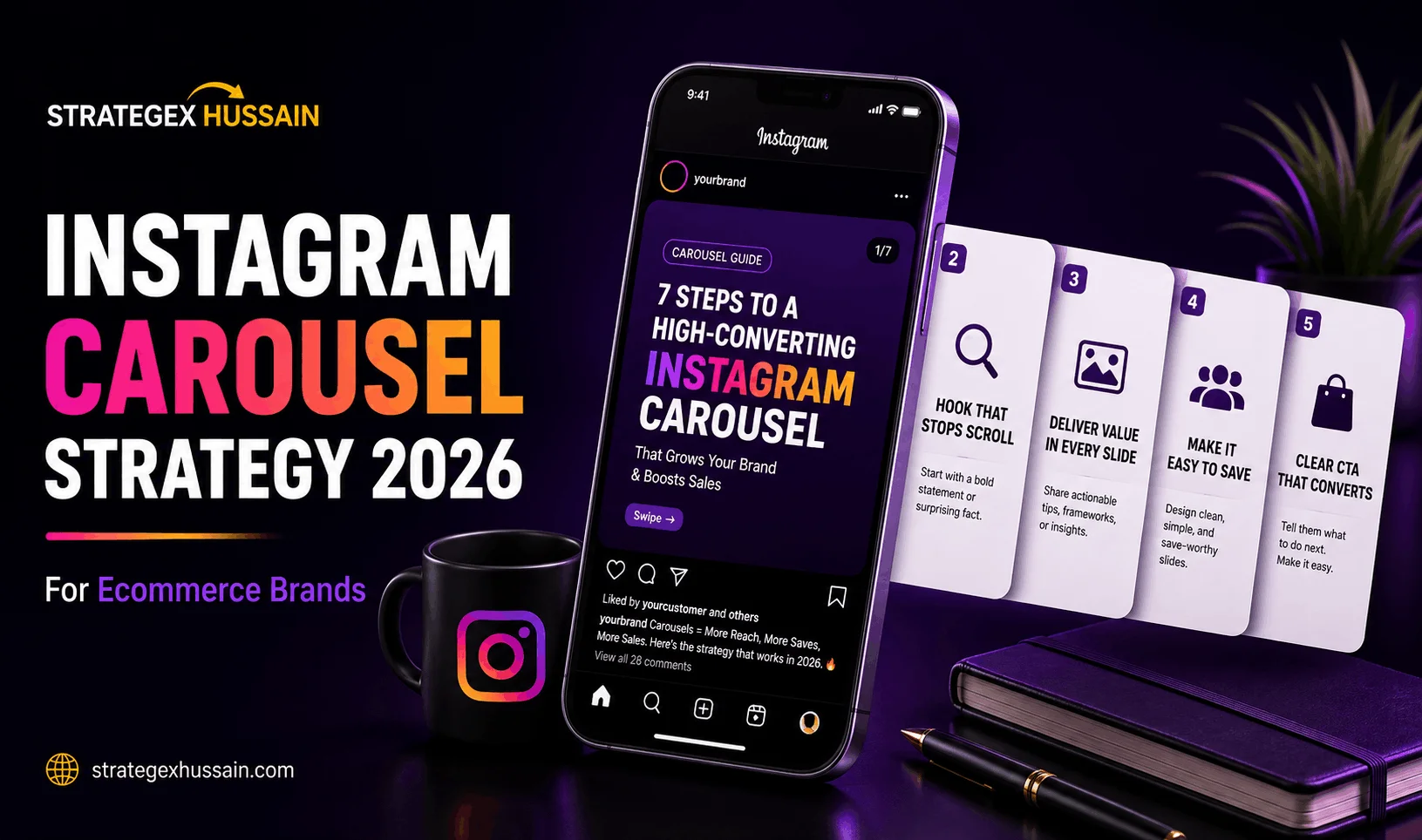
Pillar 1: The Hook Slide
Your first slide is your entire shot at engagement. It determines whether someone swipes to slide 2 or keeps scrolling. If your first slide does not stop the scroll, nothing else in your carousel matters.
Your hook slide needs to accomplish three things simultaneously. First, it needs to stop the scroll visually. Use high contrast, bold colors, or unexpected imagery. Something that looks different from every other post in the feed. Second, it needs to communicate immediate value. Whether it is a question that triggers curiosity, a bold statement that provokes thought, or a preview of a transformation, people need to understand in under two seconds why they should care. Third, it needs to tease what is coming. Create an open loop. “Swipe to discover…” “These 7 mistakes are costing you sales…” “The number one reason your ads are failing…” All of these establish expectation and create the motivation to keep going.
For ecommerce brands specifically, the highest performing hook slides show a dramatic result, a surprising statistic about the industry, a common mistake your customer is making right now, or a transformation that your product enables. The hook is everything. Spend more time on slide 1 than any other slide in your carousel.
Pillar 2: The Story and Journey Slides
Slides 2 through 8 are where carousels separate themselves from every other format. You have space to tell a complete story. To build context. To guide your audience through a narrative that moves them emotionally before you ask them to act.
The best carousel stories follow a clear pattern. Slides 2 and 3 establish the problem or the context. What is the situation your audience is in? What pain are they experiencing? What challenge are they facing? Slides 4 through 6 walk through the solution, the steps, or the transformation. This is where you deliver the core value. Slides 7 and 8 deepen understanding with proof, data, or secondary benefits that reinforce the case you have been building.
Keep each slide focused on one idea. Do not try to cram three points onto a single slide. The power of the carousel format is that each slide gets its own moment of attention. Respect that. One slide, one idea, one clear visual.
Optimal carousel length for ecommerce: 6 to 13 slides. Anything shorter and you lose the narrative advantage. Anything longer and engagement drops off significantly. The sweet spot for most product-focused carousels is 8 to 10 slides.
Pillar 3: The Proof and Credibility Slides
This is where carousels become marketing superpowers that no other format can replicate.
After you have told your story and engaged someone emotionally, you ground everything in credibility. Customer testimonials. Before and after results. Specific numbers. Real data. By the time someone reaches slide 7 or 8 they are already invested in your narrative. They are far more receptive to proof at this point than they would have been at slide 1.
For ecommerce brands this is the slide where you show real customer results. Real reviews with names and photos. Specific metrics. “She lost 12 pounds in 6 weeks.” “We shipped 4,000 orders last month.” “Our customers rate us 4.9 stars across 2,300 reviews.” Specificity builds credibility. Vague claims do not convert anyone. Real numbers do.
Do not make your entire carousel data heavy. Nobody wants to swipe through charts and graphs. But placing two or three proof slides strategically in the back half of your carousel, after you have already won the emotional argument, is one of the most powerful conversion moves available to ecommerce brands on Instagram.
Pillar 4: The Interactive Engagement Slide
Before your final call to action, create a moment that invites participation. This slide transforms your audience from passive consumers into active participants and the difference in engagement metrics is dramatic.
The best interactive slides ask questions that require more than a one word answer. Opinion based questions. Experience based questions. Prediction based questions. “Which of these resonates most with your situation?” “What has been your biggest challenge with this?” “Which option would you choose and why?” Comments with more words now weigh heavier in the Instagram algorithm. A comment that says “wow” counts for far less than a comment that says “I have been struggling with this for months and option 2 is exactly what I needed.” Design your interactive slide to inspire the second type.
You can also use this slide for a game mechanic. “Go back to slide 3. Did you catch the detail we hid there?” “Spot the difference between slide 2 and slide 5.” These mechanics keep people swiping back, which Instagram counts as additional engagement and extended session duration.
Pillar 5: The Call to Action Slide
Your final slide is not a passive moment. It is a direct instruction. And research consistently shows that posts with explicit calls to action receive 20 to 30 percent more engagement than those without clear direction.
Different calls to action drive different engagement types and different engagement types carry different algorithmic weight. Comments signal discussion and content quality. Saves signal future utility and planning intent. Shares via DMs are the algorithm’s number one discovery signal — they tell Instagram that your content is worth recommending to someone else.
For ecommerce brands your final slide should match your business goal. If you want to drive sales: “Tap the link in bio to shop now.” If you want to build your email list: “Save this and DM us for the full guide.” If you want engagement: “Comment the number of the tip that hit hardest.” Never end a carousel without a clear instruction. Every slide you built leads to this moment. Make it count.
12 Carousel Formats That Dominate for Ecommerce Brands in 2026
Understanding the framework is one thing. Knowing which specific formats to use for your ecommerce brand is what separates theory from results. Here are the 12 formats that are consistently outperforming everything else right now.
Format 1: The Before and After Transformation
Perfect for beauty, skincare, fitness products, home improvement, and any product with a visible result. Hook with the dramatic after. Walk through the journey in the middle slides. Close with proof and a CTA. This format triggers aspiration and hope, two of the most powerful purchase motivators that exist.
Format 2: The Step by Step Tutorial
Show the finished result on slide 1 as the hook. Walk through each step one per slide. Include a pro tip or common mistake slide near the end. Close with “try this and tag us.” Tutorial carousels generate extraordinary save rates because people bookmark them to reference later. Every save is an algorithmic signal that your content has real utility.
Format 3: The Myth Busting Carousel
Start with “5 myths about [your product category] that are costing you money.” One myth per slide with the truth underneath. Back it up with data or an expert perspective. End with “which myth surprised you most?” This format drives comments because people engage with information that challenges what they believed. High comment count equals high algorithmic distribution.
Format 4: The Product Showcase Sequence
Slide 1: Hero shot with a benefit statement that leads with the result, not the feature. Slide 2: The problem it solves. Slides 3 through 5: Key features, one per slide. Slide 6: How it is different from alternatives. Slide 7: Who it is for specifically. Slide 8: Customer testimonial with a real name and photo. Slide 9: Pricing or current offer. Slide 10: “Tap link in bio.” This format lets prospects evaluate your product at their own pace rather than being rushed through a Reel. The buying decision often happens somewhere in slide 6 through 8 for warm audiences.
Format 5: The Customer Success Story
Start with a specific result. “How Sarah increased her skin clarity by 80 percent in 30 days.” Slide 2: Her situation before. Slides 3 through 5: The specific problem she faced. Slide 6: How she started using your product. Slides 7 and 8: The transformation with real photos. Slide 9: Her exact results quantified. Slide 10: “Ready for your result? Link in bio.” Case studies are proof that no marketing claim can replace. When you show a real result from a real person, it is more credible than anything you could say about your own product.
Format 6: The Comparison Carousel
“Which is better for you: Option A or Option B?” Walk through cost, time investment, best for beginners, best for advanced users, long term value. Close with “comment which one you would choose.” Comparison carousels help prospects self-select. By the end they have already identified their path. They are ready to convert. This format works especially well for ecommerce brands with multiple product tiers or variations.
Format 7: The Data and Stats Deep Dive
One surprising stat per slide with a strong visual representation. Walk through what the stats mean for your customer. End with a prediction and a question. Data-heavy carousels from brands that know their industry build authority fast. The key is making each stat feel like a revelation, not a lecture. Lead with the most surprising finding, not the most obvious one.
Format 8: The Resource and Checklist
“Complete checklist for [task your customer does].” One section per slide. Pro tips near the end. Final slide: “Save this for later.” Checklist carousels generate the highest save rates of any format. Every person who saves your checklist is telling the algorithm that your content has genuine utility. These posts resurface and generate engagement weeks and months after publishing.
Format 9: The I Was Wrong Carousel
Start with a bold admission of a past belief about your industry or product category. Explain why you believed it. Show what changed your mind. Walk through the evidence. End with “what belief are you holding that you should reconsider?” Vulnerability creates connection. Admitting you were wrong about something makes you more credible, not less. This format positions your brand as honest and evolving rather than just promotional.
Format 10: The Trending Topic Carousel
“Here is why [trending topic] actually matters to [your customer].” Provide context and background. Show how it affects your specific audience. Share what you are doing about it. End with “what am I missing? Drop your take in comments.” Riding trending topics gets algorithmic distribution. The carousel format lets you provide depth that a Reel cannot, positioning your brand as thoughtful rather than just chasing trends.
Format 11: The Interactive Quiz or Flowchart
“What is your [skin type / workout style / design aesthetic]? Swipe to find out.” Walk through quick questions with clear options. Lead to different recommendations based on the path. Close with a personalized product recommendation. Interactive carousels increase swipe engagement dramatically because users are not passively consuming. They are participating. This creates personal connection and makes your content far more likely to be shared.
Format 12: The Newsjacking Carousel
“Here is why [industry news] changes everything for [your customer].” Give context. Show the specific impact on your audience. Share your take on how to respond. End with “what am I missing?” Newsjacking with depth builds thought leadership and rides the algorithmic boost that trending topics receive. For ecommerce brands this works especially well for industry shifts, new research, or platform changes that affect your customer’s buying behavior.
The Design Rules That Separate Professional Carousels From Amateur Ones
Content and structure are everything. But design is what makes people trust your brand before they read a single word. Here are the non-negotiable design rules for ecommerce carousel content in 2026.
Consistency across slides. Every slide in your carousel should feel like it belongs to the same family. Same color palette. Same fonts. Same visual style. When someone swipes through and sees a cohesive visual experience it reinforces brand recall at every slide. Inconsistency signals amateurism and breaks trust instantly.
The 20 percent text rule. No single slide should be more than 20 percent text overlay. Instagram is a visual platform. Text should enhance images, not replace them. If you find yourself writing paragraphs on a slide, you are doing it wrong. One headline, maximum two lines of supporting text per slide.
Typography hierarchy. Use two fonts maximum. One bold sans-serif for headlines that creates visual impact. One clean readable font for supporting text. This creates hierarchy without clutter. Mixing three or four fonts looks chaotic and unprofessional.
Aspect ratio consistency. Use 4:5 portrait ratio for every slide. This is the optimal ratio for mobile screens and gives your carousel maximum visual weight in the feed. Mixing aspect ratios across slides is one of the most common amateur mistakes and it signals low production quality immediately.
Image quality. Every image needs to be sharp, well lit, and high resolution at minimum 1080 pixels wide. Blurry or dark images get scrolled past regardless of how good your copy is. On a platform where visual quality signals brand quality, fuzzy images are commercial suicide for ecommerce brands.
Brand colors in every slide. Your brand colors should appear consistently throughout every carousel you publish. Over time this creates a visual signature that followers recognize before they read your name. Brand recognition at the scroll level is one of the most underrated competitive advantages in Instagram marketing.
The Instagram Carousel Strategy 2026 Content System: Think Series Not Posts
The difference between brands that see consistent carousel success and those that post sporadically comes down to one thing: systematic strategy rather than individual post excellence.
The brands winning with carousels in 2026 are not creating one great post and hoping it goes viral. They are building content systems. Specifically, they are creating carousel series that function as complete funnels.
Here is what a carousel series looks like in practice for an ecommerce brand. Let us say you sell skincare products.
Carousel 1: “The 3 mistakes keeping you from clear skin” — attracts through pain identification. This carousel generates reach and comment engagement as people recognize their own mistakes.
Carousel 2: “Here is the science behind why those mistakes happen” — educates and builds authority. This carousel generates saves as people bookmark the explanation.
Carousel 3: “The exact routine that fixes all three” — positions your product as the solution naturally within a helpful framework. This carousel generates saves and profile visits.
Carousel 4: “Real customers. Real results. Here is the proof.” — converts. This carousel generates DMs and link in bio clicks from warm prospects who have followed the entire series.
These four carousels function as a sales funnel in carousel form. Carousel 1 attracts through pain identification. Carousel 2 educates. Carousel 3 positions the solution. Carousel 4 converts. By creating series rather than standalone posts you compound reach across multiple posts, create narrative continuity that keeps followers tracking your content, establish deep authority on the topic, and generate saves and shares at a series level rather than just a post level.
Define 3 to 4 content pillars for your brand and map every carousel you create to one of them. For an ecommerce brand a strong pillar structure might look like this:
Pillar 1: Transformation Stories (20 percent of carousels) — Real customer results and case studies. High trust content that drives conversions from warm audiences.
Pillar 2: Education and How-To (30 percent of carousels) — Step by step processes, tutorials, and frameworks relevant to your product category. High save rate content that builds authority.
Pillar 3: Proof and Data (20 percent of carousels) — Industry research, product performance data, customer reviews at scale. Credibility building content.
Pillar 4: Interactive and Community (30 percent of carousels) — Quizzes, comparison carousels, myth busting, and opinion pieces. High comment rate content that drives algorithmic distribution.
This distribution ensures you are not monotonous while maintaining strategic focus. Every carousel you create has a job. Every job contributes to the overall system.
The Amplification Strategy: What to Do After You Publish
Publishing the carousel is 30 percent of the work. What you do in the 48 hours after publishing determines whether your post reaches 500 people or 50,000.
First 30 minutes: Reply to every comment within 30 minutes of publishing. This signals to Instagram that your post is creating active conversation. The algorithm watches early engagement velocity. High early engagement triggers broader distribution to a larger audience. This is not optional. It is the single highest leverage action you can take after posting.
First 2 hours: Like and reply to all new comments. Answer questions fully. Spark further discussion by asking follow up questions in your replies. The longer the comment thread grows in the first two hours the more aggressively Instagram pushes the post.
First 24 hours: Respond to all remaining comments. Pin the best comment to the top of the thread. Engage with anyone who shared your carousel to their Stories. DM them a genuine thank you. This creates relationship capital and makes them more likely to share your content again.
Day 2: Repurpose the carousel content. Take the most engaging slide and post it as a standalone Story with a poll or question sticker driving people back to the original post. Extract the key insight and create a short Reel teaser that drives people to the carousel for the full breakdown. If you have an email list, send a newsletter referencing the carousel and linking to your Instagram profile.
Every high performing carousel you create should get amplified across formats. Carousel becomes Story. Story drives Reel. Reel drives blog post. Blog post drives email. Email drives back to Instagram. This multiplication strategy means your carousel does not just live and die in the feed. It generates traffic across every channel you own.
The Evergreen Carousel Archive: Turning Content Into a Long Term Asset
Most brands treat their carousels as one-time production efforts. Post it. Get the engagement. Move on. That is a massive waste of the best content you create.
The smartest ecommerce brands on Instagram build an evergreen carousel archive. These are high performing posts that remain relevant regardless of when they are published. They get reshared every 6 to 8 weeks as your audience grows and new followers who missed them the first time see them fresh.
Examples of evergreen carousels every ecommerce brand should have in their library:
“5 common mistakes [your audience] makes with [your product category]” — this post will be relevant for years and can be reshared repeatedly.
“Complete beginner’s guide to [your product category]” — this generates saves every single time it is posted because new people are always entering your niche.
“How to choose the right [product] for [specific outcome]” — high save rate content that positions you as the authority in your category.
“Our best selling products and why they work” — seasonal resharing with updated results keeps this evergreen.
Track your top 10 performing carousels in a spreadsheet. Note the original post date, last reshared date, performance metrics, and next scheduled reshare. This turns your carousel library into a recurring asset rather than a collection of one time posts. A brand with 20 strong evergreen carousels has a content foundation that generates engagement indefinitely.
Measuring What Actually Matters: The Carousel Metrics That Drive Decisions
Vanity metrics will make you feel good and tell you nothing useful. Here are the metrics that actually matter for your instagram carousel strategy 2026 and what each one tells you about performance.
Save rate. This is the most important metric for carousels in 2026. A high save rate tells you that your content has genuine utility. People are bookmarking it to return to later. Saves are the strongest signal to the Instagram algorithm that your content deserves wider distribution. If your save rate is low, your content is not delivering enough value. People like it but they do not need it. Fix the content before you fix anything else.
Swipe through rate. How many people swiped past slide 1 to see more. This tells you whether your hook is working. If most people are not swiping past your first slide, no amount of excellent content on slides 2 through 10 will save the post. A low swipe through rate is always a hook problem.
Comment length and quality. Not just how many comments, but how long they are. Short emoji comments carry minimal algorithmic weight. Long thoughtful comments signal quality discussion to the algorithm. If you are getting lots of short comments, redesign your interactive slide to ask questions that require more than a one word answer.
DM shares. When someone shares your carousel to a friend via DM it is the strongest discovery signal Instagram has. It means your content was valuable enough to recommend. Track how many DM shares your best carousels receive and study what they have in common. Replicate those elements in every carousel going forward.
Profile visits from the post. A high number of profile visits after a carousel tells you the content made someone curious enough to want to know more about your brand. This is warm intent. These people are one step from following you and one step from buying.
Click through rate on link in bio. For ecommerce brands this is ultimately the metric that connects Instagram to revenue. Track which carousels drive the most link in bio clicks and use that data to understand which content formats are most effective at moving people from content consumption to purchase intent.
The 30 Day Instagram Carousel Strategy 2026 Launch Plan
Theory without execution is worthless. Here is the exact 30 day plan to build your carousel system from scratch or rebuild it if your current approach is not working.
Week 1: Audit and Research
Go into your Instagram Insights and pull performance data on every carousel you have published in the last 90 days. Identify your top 5 performing carousels. What do they have in common? Format, topic, length, CTA, visual style? Write down every pattern you notice. These patterns are your starting data. They tell you what your specific audience already responds to.
Next study the top 20 carousel posts in your niche. Not your own content. Your best performing competitors and the top educational accounts in your product category. Document what makes their hook slides work. What formats they use most. How long their carousels are. What their CTAs look like. You are not copying them. You are understanding the baseline of what works in your space.
Week 2: Build Your Framework
Define your 3 to 4 content pillars based on your business goals and the patterns you identified in week 1. Create slide templates for each pillar so every carousel you produce has a consistent visual foundation. You can use Canva or Adobe Express to build these templates in under two hours.
Map out your next 8 weeks of carousel content using your pillar framework. You do not need to know every detail of every post. You need to know which pillar each post serves, the core topic, and the format you will use. This calendar becomes your production guide.
Week 3: Create Your First Series
Design 4 carousels that function as a series following your pillar framework. This is your proof of concept. You are testing whether the system works before you scale it. Keep the production quality high but do not let perfectionism slow you down. A good carousel published consistently beats a perfect carousel published occasionally every single time.
Prepare your engagement response protocol before you publish the first one. Know that you will be in the comments for 30 minutes after each post goes live. Block that time in your calendar. Treat it as non-negotiable.
Week 4: Launch, Measure, and Refine
Publish your series on your planned cadence. Track every metric for every post. After 7 days compare the performance of your 4 carousels to your historical baseline. What improved? What underperformed? What surprised you?
Conduct your first A/B test on hook slides. Create two versions of your next carousel with different hook approaches. Publish them 5 days apart to the same audience. Measure which generates more swipe-throughs. Document the result. This is the beginning of your performance data library.
Month 2 and Beyond: Scale the System
Continue publishing on cadence. Run one A/B test per month minimum. Repurpose your best carousels into Stories, Reels teasers, and email content. Start building your evergreen archive. Track cumulative carousel impact on follower growth, engagement rate, and most importantly link in bio clicks and revenue.
At 90 days you will have enough data to know exactly what your audience responds to. You will have a content system running on its own momentum. And you will understand your competitors less as threats and more as benchmarks that you are steadily moving past.
Common Carousel Mistakes That Are Killing Your Ecommerce Results
Before you build your strategy, understand the mistakes that are quietly sabotaging carousel performance for most ecommerce brands right now.
Inconsistent aspect ratios. Using different dimensions on different slides breaks the visual experience and signals low production quality. Standardize everything at 4:5 before you publish another carousel.
No narrative connection between slides. Each slide feels like a separate post rather than part of a continuing story. Your audience should feel compelled to swipe because they want to know what comes next, not because they are hoping the next slide is better than the one they just saw.
Weak or missing CTA on the final slide. Ending with a product photo and nothing else is one of the most common and most expensive mistakes in ecommerce carousel content. Your final slide should always tell people exactly what to do next.
Publishing and disappearing. Posting and not engaging with comments for hours after publishing is giving up the highest leverage moment for algorithmic distribution. The first 30 minutes after you publish are more valuable for engagement than any other time window.
Text overload. Slides that are more text than image feel like reading a document. Instagram is not a document platform. If your audience wanted to read they would open a blog. Keep text minimal, visual impact maximum.
Random posting with no pillar system. Publishing carousels on random topics with no strategic framework means you are building no cumulative authority in any area. Every post starts from zero. Build pillars and stick to them. Authority compounds. Random content does not.
Frequently Asked Questions About Instagram Carousel Strategy 2026
How many slides should an ecommerce Instagram carousel have?
The optimal length for ecommerce carousels is 8 to 10 slides. This gives you enough space to tell a complete story, deliver value, include proof, and end with a strong CTA without losing people before they reach the end. Carousels under 6 slides often feel incomplete. Carousels over 13 slides see significant engagement drop off.
What type of carousel gets the most saves on Instagram?
Checklist and resource carousels consistently generate the highest save rates because they have obvious future utility. Tutorial and step by step carousels are a close second. If your goal is saves specifically, build content that people will want to reference later rather than content that is purely entertaining in the moment.
Should I use video or images in my ecommerce carousels?
In 2026 the best performing carousels mix both. Use video slides for moments that benefit from motion — product demonstrations, unboxing reveals, before and after animations. Use image slides for information, proof, and anything that benefits from people being able to pause and read at their own pace. Instagram now supports up to 20 mixed images and videos in a single carousel.
How often should I post carousels for my ecommerce brand?
For accounts under 10k followers: 1 high quality carousel per week alongside 2 to 3 Reels. For accounts between 10k and 100k: 2 to 3 carousels per week. For accounts over 100k: 3 to 4 carousels per week as your primary content format. Consistency matters more than frequency. One excellent carousel per week published consistently will always outperform three mediocre ones posted sporadically.
Why are my Instagram carousels not getting engagement?
The most common reasons are a weak hook slide that does not stop the scroll, no clear narrative connecting the slides, a missing or weak CTA on the final slide, and not engaging with comments in the first 30 minutes after posting. Check all four before changing anything else about your content strategy.
The Bottom Line: Carousels Are Not the Future, They Are the Present
The data is clear. The brands winning on Instagram in 2026 are not choosing between Reels and carousels. They are using both strategically, understanding exactly what job each format performs. But they are investing disproportionate energy into carousels because that is where engagement lives and engagement drives everything else.
A 10 percent engagement rate versus 6 percent for Reels. A 95 percent higher save rate. A 27 percent longer session duration. 3.1 times higher engagement than single image posts. These are not small differences. These are competitive advantages that compound over months and years for the brands that build a real instagram carousel strategy 2026 and execute it consistently.
Your competitive advantage is not a single carousel. It is a systematic strategy that treats carousels as a core business asset. Hook slides that stop the scroll. Narratives that build emotional investment. Proof slides that close the argument. Interactive slides that generate algorithmic weight. CTAs that move people from content to commerce.
Build the system. Execute consistently. Test relentlessly. Optimize based on data not feelings. In 90 days you will have a carousel engine that does not just perform occasionally. It dominates.
You can also read our posts on Instagram marketing strategy 2026 and why most ecommerce brands waste money on Meta Ads to build a complete Instagram and paid strategy around your carousel content system.
The window to get ahead of your competitors on carousels is still open. The brands moving now are the ones who will own their category on Instagram 12 months from now.
Which side of that line are you going to be on?
Want a done-for-you Instagram carousel strategy built specifically for your ecommerce brand? We create, manage, and optimize Instagram content that drives real sales. Get a Free Proposal here.