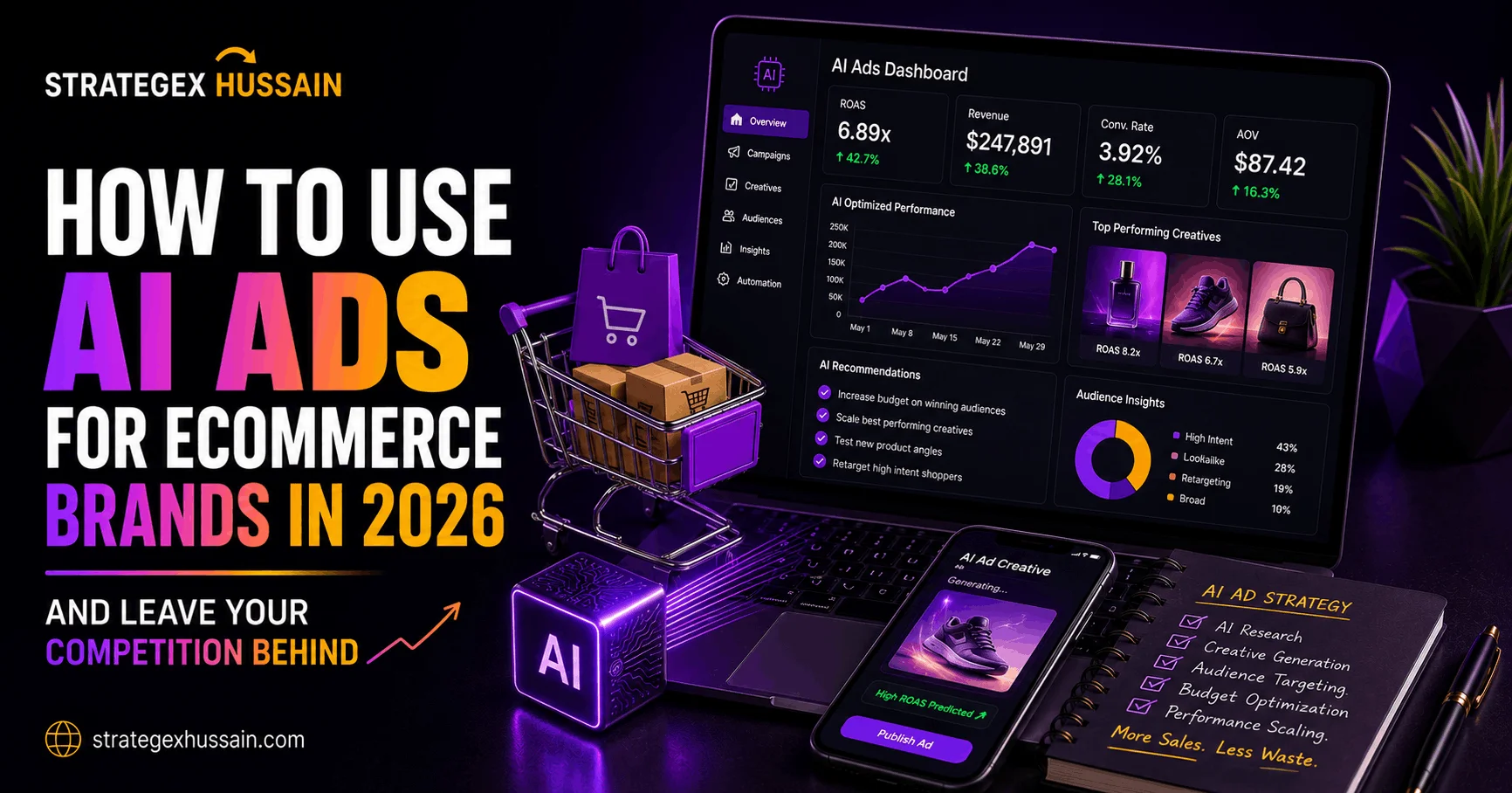
Your competitor is spending less than you on ads and getting better results. You have seen it. Same product category, similar audience, but their ROAS is climbing while yours is stuck. Here is the uncomfortable truth: AI ads for ecommerce are the gap, not their budget and not even their creative. They are running campaigns built around AI ads for ecommerce while you are still managing things the old way, manually adjusting bids, guessing at audiences, and rotating creatives based on gut feel. In 2026, that approach is not just slow. It is actively costing you money every single day. This guide is going to show you exactly how to use AI ads for ecommerce the right way, what platforms are doing it best, where most brands get it wrong, and how to build a system that scales without requiring you to live inside Ads Manager.
Why AI Ads for Ecommerce Are Not Optional in 2026
There was a time when running paid ads was a game of who had the best human instincts. You tested audiences manually. You watched metrics daily and made adjustments based on what you saw. You built ad sets around your assumptions about who your customer was. That era is over. Not because human judgment does not matter anymore, it absolutely does, but because the volume and speed of data that modern ad platforms generate has completely outpaced what any human can process manually.
Meta alone processes billions of data points every second across its auction system. The signals that determine whether your ad wins an impression, how much you pay for it, and whether the person who sees it is actually likely to buy from you, all of that is being calculated in real time at a scale that no spreadsheet and no human brain can compete with. AI ads for ecommerce exist precisely because of this reality. The platforms built AI into their ad systems not to take control away from advertisers, but because it was the only way to make the auction work efficiently at that scale.
But here is what most ecommerce brand owners miss. The AI inside Meta Advantage Plus, Google Performance Max, and TikTok Smart Performance Campaigns is not just running your ads. It is learning from your data, optimizing toward your goals, and finding customers you would never have thought to target manually. When you fight the AI, when you over-restrict it with tight audience targeting and rigid campaign structures, you get worse results. When you learn to work with it, giving it the right inputs, the right creative variety, and the right objective signals, it compounds your performance over time.
This is the shift that separates the ecommerce brands scaling aggressively in 2026 from the ones wondering why their ROAS keeps declining despite spending more. If you want to understand where paid media fits into your overall ecommerce growth, read our breakdown of Meta Ads vs Google Ads for Ecommerce to see how AI is changing both platforms differently.
How AI Ads for Ecommerce Actually Work
Before you can use AI ads for ecommerce effectively, you need to understand what they actually do. Not at a surface level, but deeply enough that you stop making decisions that undermine them.
Signal Processing at Scale
Every action a user takes on a platform is a signal. A scroll, a pause, a click, a hover, a purchase, a return visit, a search query, an app they use, content they engage with at 2am versus 2pm. Meta, Google, and TikTok have been collecting these signals for years across billions of users. Their AI models use this data to build extraordinarily detailed behavioral profiles that go far beyond basic demographic targeting. When you tell Meta’s AI to find buyers for your skincare product, it is not just looking for women aged 25 to 45 who listed beauty as an interest. It is finding people whose behavioral patterns across the entire platform ecosystem look like those of people who have purchased similar products before, even if those people never clicked on a single beauty ad in their life.
This is why broad targeting often outperforms narrow targeting when you are working with AI-powered campaigns. The AI knows things about user intent that your manually defined audience cannot capture. The more room you give the AI to explore, the more it can find.
Dynamic Creative Optimization
AI ads for ecommerce do not just optimize who sees your ad. They optimize what those people see. Dynamic Creative Optimization, or DCO, is the technology that lets you feed multiple headlines, images, videos, descriptions, and CTAs into a campaign and let the AI figure out which combinations perform best for which audiences. Instead of you picking one creative and running it, the system tests hundreds of combinations simultaneously at a scale you could never achieve manually and automatically allocates spend to the winning combinations.
This is not just A/B testing. It is multivariate testing at machine speed. And it means your creative strategy changes. Instead of agonizing over which one ad to run, your job becomes feeding the AI with enough high-quality raw ingredients, headlines that speak to different pain points, visuals that show the product in different contexts, CTAs that appeal to different buyer motivations, and letting the machine optimize the assembly.
Predictive Bidding
If not configured properly, automated smart bidding can lead to brands wasting budget on Facebook ads or Google campaigns. The bidding side of AI ads for ecommerce is where some of the biggest efficiency gains live. Manual bidding strategies, even smart ones, are reactive. You see your CPA climbing and you adjust your bid cap. You notice your CPM spiking and you change your audience. All of these adjustments happen after the fact, based on data that is already 24 to 48 hours old. AI-powered bidding is predictive. It adjusts bids in real time at the auction level based on the probability that a specific impression will result in your desired outcome. Before your ad even serves, the AI has already calculated the likelihood that this particular user, in this context, at this moment, will convert, and it bids accordingly.
When you set your campaign objective correctly and give the AI enough conversion data to learn from, this predictive bidding compounds over time. The model gets better, your CPA comes down, and your spend becomes more efficient without you touching anything. But it only works if you let it. If you keep making manual overrides, changing budgets dramatically, switching objectives mid-learning, or adding audience restrictions, you disrupt the learning cycle and reset the model’s progress.
Platform by Platform: AI Ads for Ecommerce on Meta, Google, and TikTok
Each major ad platform has its own AI system with its own strengths, weaknesses, and best practices. Understanding the differences is critical because what works on Meta will not always work on Google, and TikTok requires a completely different approach from both. Let us go through each one.
Meta Advantage Plus: The Ecommerce AI Powerhouse
Meta’s Advantage Plus Shopping Campaigns, often called ASC, are the most mature and battle-tested AI ad product available for ecommerce right now. When you run an Advantage Plus Shopping Campaign, you hand Meta’s AI almost complete control over audience targeting, placement, creative combinations, and budget allocation. In return, Meta’s system uses everything it knows about user behavior across Facebook, Instagram, Messenger, and the Audience Network to find your buyers with remarkable efficiency.
The results speak for themselves. Brands that have shifted significant budget into Advantage Plus campaigns are consistently seeing lower CPAs and higher ROAS compared to their manual campaign counterparts, particularly when they are past the learning phase and have enough pixel data for Meta’s model to work with. The generally accepted benchmark is 50 purchase events per ad set per week for the algorithm to exit the learning phase and start performing predictably. If you are below that volume, you need to either consolidate your campaigns or broaden your objectives temporarily to generate more signal.
The most important thing you can give Meta’s AI is creative variety. Feed it at least eight to ten creative assets across different formats, including single images, carousels, and video. Include creatives that speak to different stages of awareness. Some people seeing your ad have never heard of your brand. Others have visited your site three times. Others abandoned a cart yesterday. Your creative library needs to speak to all of them, and Meta’s AI will figure out who gets which creative.
Pair strong AI campaign structure with compelling copy using the principles from How to Write Meta Ads Copy That Actually Converts and you have a genuinely powerful system working for your ecommerce brand.
Google Performance Max: AI Across Every Google Surface
Google’s Performance Max, or PMax, is arguably the most ambitious AI ad product ever built. A single PMax campaign serves ads across Search, Shopping, Display, YouTube, Gmail, and Google Maps simultaneously. The AI decides not just who sees your ad but which surface they see it on, what format it takes, and how much to bid for each impression across all of those channels at once.
For ecommerce brands, PMax has become essential because it combines the buying intent of search, the visual discovery of Shopping, and the reach of YouTube into one unified campaign. The AI cross-references signals across all of these surfaces to find users at different points in the purchase journey and serve them the right message in the right format at the right moment.
The critical success factor for PMax is your asset group. Think of an asset group as the creative brief you give the AI. You provide headlines, descriptions, images, logos, and videos, and the AI assembles them into ads across every format and surface. The quality and variety of what you provide directly determines the quality of what the AI can produce. Skimpy asset groups produce generic ads. Rich, varied, on-brand asset groups give the AI room to build compelling ads that actually stop the scroll and drive clicks.
One thing to be aware of with PMax is brand search cannibalization. PMax campaigns can show on brand name searches, which means you might be paying for clicks from people who were already searching for you by name and would have come to your site anyway. Use brand exclusions in your PMax settings to prevent this and protect your branded search traffic.
TikTok Smart Performance Campaigns: The New Ecommerce Frontier
TikTok’s Smart Performance Campaigns are the youngest of the three but they are growing fast in capability and results. The TikTok AI has one significant advantage over Meta and Google: the platform’s content signals are extraordinarily rich. Every video watched to completion, every comment, every share, every product tap, every time someone watches a review video and then searches the brand, all of this feeds TikTok’s targeting model with behavioral data that is deeply connected to purchase intent.
For ecommerce brands running TikTok Shop, the integration between organic content signals and paid campaign targeting is particularly powerful. When your organic videos generate engagement, those engagement signals feed your paid campaigns and make them smarter. This is a flywheel effect that does not exist on Meta or Google to the same degree, and it is why brands that commit to both organic and paid on TikTok consistently outperform brands doing paid only.
The creative requirement on TikTok is also different. The AI can optimize all it wants, but if your creative does not feel native to the platform, users will scroll past it instantly. TikTok ads that look like ads perform poorly. TikTok ads that look like organic content, raw, authentic, human, and entertaining, perform exceptionally. This is a fundamental creative constraint that no amount of AI optimization can overcome. For more on building a TikTok strategy that feeds your paid campaigns, see How to Get Your First 1000 Sales on TikTok Shop.
Building Your Creative Strategy Around AI Ads for Ecommerce
This is where most ecommerce brands completely misunderstand how AI ads work. They treat the creative as secondary, something to throw together quickly before launching the campaign and trusting the AI to do the heavy lifting. The opposite is true. Creative is the single most important input you give an AI ad system. Everything else, the audience, the bidding, the placement, gets optimized by the machine. The creative is your contribution to the equation, and if it is weak, no amount of AI optimization will save it.
Volume and Variety Over Perfection
The first principle of building creative for AI campaigns is volume. You need more creative than you think. Not ten variations of the same thing with slightly different text. Genuinely different creative concepts that approach your product from different angles. One creative shows the product in use. Another shows the transformation or result. Another leads with a problem the customer has. Another features a customer review or testimonial. Another is pure entertainment value with the product woven in naturally.
When you give the AI this kind of variety, it can match the right creative concept to the right person based on their behavioral signals. Someone who responds to problem-solution content gets served the problem-solution ad. Someone who responds to social proof gets the testimonial. Someone in the entertainment mindset gets the entertaining one. You cannot make those matches manually at scale. The AI can.
UGC as AI Fuel
User-generated content is one of the highest performing creative formats for AI-powered ecommerce campaigns right now. There are two reasons for this. First, UGC looks authentic and native to social platforms, which means users engage with it rather than scrolling past it. Second, UGC tends to touch on real customer language, real objections, real use cases, and real results, which means it resonates at a deeper level than polished brand creative.
When you feed UGC into your AI campaigns alongside your polished brand creative, you give the AI both ends of the creative spectrum to optimize with. It finds the right format for the right person. This combination consistently outperforms either type of creative alone. If you are not already building a systematic UGC collection process for your ecommerce brand, that needs to change immediately.
Video Length and Format Strategy
For AI campaigns across Meta and TikTok, video is the dominant format by performance. But not all video performs equally. Short-form video under 15 seconds works best for top-of-funnel awareness and reach. Videos in the 30 to 60 second range work well for consideration campaigns where you have more to explain or demonstrate. Longer videos, one to two minutes, work best for retargeting audiences who already know your brand and are closer to a purchase decision.
When building your creative library for AI campaigns, produce content across all three of these length categories. The AI will serve the right length to the right person based on where they are in the funnel. If you only have 15-second clips, you are leaving the consideration and retargeting segments underserved and your AI system will have nothing good to show people who are almost ready to buy.
Data and Tracking: The Foundation AI Ads Are Built On
You can have the best creative in the world and the most generous budget in your category, but if your tracking is broken, your AI campaigns will fail. This is non-negotiable. AI ad systems learn from conversion data. If that data is incomplete, delayed, or inaccurate, the AI is making optimization decisions based on a distorted picture of reality. It will optimize toward the wrong things, find the wrong people, and waste your budget with absolute confidence that it is doing the right thing.
Meta Pixel and Conversions API
Meta’s AI campaigns learn from the events your pixel fires. If you are only firing page view and add-to-cart events and your pixel is not reliably firing purchase events, Meta’s algorithm has almost no signal to work with. Get your pixel firing purchase events with order values accurately. Then go a step further and implement the Conversions API, which sends conversion data directly from your server to Meta rather than relying solely on browser-based pixel tracking. This matters enormously because iOS privacy changes have degraded browser-based tracking significantly. Server-side events through the Conversions API fill in the gaps and give Meta’s AI cleaner, more complete data to learn from.
Google Tag Manager and Enhanced Conversions
For Google PMax campaigns, your Google Ads conversion tracking needs to be set up with Enhanced Conversions enabled. Enhanced Conversions use hashed first-party data from your customers, things like email addresses collected at checkout, to match conversions more accurately when cookies are not available. This dramatically improves the quality of the conversion data feeding your PMax campaigns and makes the AI’s optimization decisions significantly more accurate.
First Party Data as a Competitive Weapon
Your email list, your customer purchase history, your loyalty program members, these are first-party data assets that you can feed directly into your AI ad campaigns to give them a head start. On Meta, you upload customer lists as Custom Audiences and then let the AI build Lookalike Audiences from them. On Google, you do the same through Customer Match. The AI uses your existing customer data as a seed to find more people who look and behave like your best buyers. The better your customer data, the better the Lookalike audience, and the faster your AI campaigns ramp to profitability.
Advanced AI Ads Strategies for Ecommerce Brands Ready to Scale
Once you have the fundamentals working, there is a second level of strategy that unlocks significantly more performance. These are the moves that distinguish brands managing a few thousand dollars a month in ad spend from the ones scaling to six and seven figures in monthly revenue through paid media.
Campaign Architecture That Feeds the AI
One of the most common mistakes ecommerce brands make with AI campaigns is over-segmenting their account structure. They build separate campaigns for every product category, every audience segment, every geographic region, and every funnel stage. The result is that no individual campaign has enough conversion volume to exit the learning phase properly. The AI in each campaign is starved of data and never reaches full optimization potential.
The smarter approach is consolidation. Fewer campaigns with larger budgets and broader parameters give the AI more data faster and allow the learning phase to complete more quickly. Once a consolidated campaign is performing well, you can gradually introduce more specificity. But start broad, let the AI find what works, and then refine based on what it learns.
Layering AI Platforms for Full-Funnel Coverage
The most sophisticated ecommerce brands in 2026 are not choosing between Meta AI and Google AI. They are layering them deliberately to cover the full customer acquisition funnel. TikTok Smart Performance Campaigns generate awareness and discovery at the top of the funnel, introducing your brand to people who did not know they needed your product. Meta Advantage Plus captures the consideration and conversion in the middle and bottom of the funnel, following up with people who have shown interest. Google PMax captures high-intent search behavior at the very bottom, catching buyers who are actively ready to purchase.
Each platform’s AI feeds on different signals and reaches people in different mindsets. When you orchestrate them together, you create a system where your brand is present at every stage of the customer journey, with AI optimizing each touchpoint for maximum efficiency. This is what a genuinely modern ecommerce advertising operation looks like, and it is the kind of infrastructure that the team at Strategex Hussain helps brands build from the ground up. You can explore all of our ecommerce advertising services here.
Creative Refresh Cadence That Keeps AI Learning
AI campaigns experience creative fatigue just like manual campaigns do, but the signals are different. Rather than watching your frequency number and guessing, with AI campaigns you watch your thumb stop rate, your hold rate, and your creative-level ROAS. When these metrics start declining on specific creatives, that is the signal to introduce new assets. The AI will automatically shift spend toward the new creatives as it learns they are performing better.
Build a creative refresh cadence into your operation. Depending on your spend level, this might be weekly, biweekly, or monthly. The higher your spend, the faster your creatives fatigue because more people are seeing them more frequently. High-spend brands with serious creative operations are refreshing assets every seven to ten days. Lower spend brands can often go three to four weeks between refreshes. But do not wait until your results collapse to refresh. Introduce new creative proactively before the decline hits.
Using AI Tools Outside the Ad Platforms
AI ads for ecommerce is not just about what happens inside Meta or Google. There is an entire ecosystem of AI tools that feed into your ad performance. AI creative tools like AdCreative.ai and Pencil generate ad variations at scale. AI copywriting tools help you produce headline variations and body copy faster. AI analytics tools process your campaign data and surface insights that would take a human analyst hours to find. When you stack these tools around your platform AI campaigns, you create compounding advantages that your competitors cannot easily replicate.
The brands winning with AI ads in 2026 are not just using one AI system. They are building AI-powered workflows that touch every stage of the campaign process, from brief to creative to launch to optimization to reporting. Each step becomes faster, smarter, and more data-driven. And the cumulative effect is an advertising operation that gets better every single week without proportionally more human effort.
Common Mistakes Brands Make with AI Ads for Ecommerce
The potential of AI ads for ecommerce is enormous, but the failure rate among brands that try to use them incorrectly is equally enormous. Here are the most expensive mistakes you need to avoid.
Touching Campaigns During the Learning Phase
This is mistake number one and it kills more AI campaigns than anything else. When you launch an AI-powered campaign, the system enters a learning phase where it is actively figuring out the best way to deliver your ads. During this phase, performance is often erratic. Your CPA might look terrible for the first few days. Your ROAS might be below target. This is normal. But most brand owners panic and start making changes, adjusting budgets, swapping creatives, changing objectives, or pausing and relaunching. Every significant change resets the learning phase. You end up in a permanent state of learning and never reach stable, optimized performance. Set your campaign up correctly from day one, define your budget, objective, and creative, and then leave it alone for at least seven to fourteen days before making any changes.
Setting the Wrong Campaign Objective
The objective you choose tells the AI what to optimize for. If you choose a traffic objective when you actually want purchases, the AI will find you people who click links, not people who buy. This sounds obvious but it happens constantly. Brands choose traffic or engagement objectives because they are cheaper, and then wonder why their conversions are terrible. Always optimize for your actual business goal. If you want purchases, optimize for purchases. If you want add-to-carts as a proxy for purchase intent when you are early in your data collection, optimize for add-to-cart. But be explicit about what you want because the AI will deliver exactly what you tell it to optimize for.
Running AI Campaigns Without Enough Creative Volume
Launching an AI campaign with two or three creatives is not giving the system enough to work with. You are asking the AI to find the optimal creative for every person in your target audience, but you have only given it two options. The result is that the AI exhausts your creative variations quickly, frequency climbs, performance declines, and you blame the AI when the real problem was creative scarcity. Always enter an AI campaign with a minimum of six to eight creative assets, ideally more, spanning different formats, messages, and concepts.
Ignoring Attribution Window Alignment
Meta’s default attribution window is seven-day click and one-day view. Google has its own attribution settings. If you are comparing performance across platforms without aligning attribution windows, you are comparing apples to oranges and making budget allocation decisions based on misleading data. Understand the attribution window each platform is using and factor that into your analysis. A sale that appears in Meta’s reporting might also appear in Google’s reporting under different attribution settings. This double-counting inflates your perceived performance and can lead you to massively overspend on channels that are not actually driving incremental revenue.
Not Excluding Existing Customers Appropriately
AI campaigns are optimized to find buyers. Your existing customers are buyers. If you do not exclude them, the AI will happily serve ads to people who already purchased from you, inflate your conversion numbers with repeat purchases, and give you the false impression that your acquisition campaigns are performing better than they actually are. Upload your customer list as an exclusion audience in your prospecting campaigns so the AI is focused on finding genuinely new customers.
Your Step by Step Plan to Launch AI Ads for Your Ecommerce Brand This Week
Enough theory. Here is the concrete action plan for getting AI-powered campaigns live and working for your ecommerce brand right now.
Start by auditing your tracking. Before you touch a single campaign setting, confirm that your Meta pixel is firing purchase events with accurate order values and that your Conversions API is set up and sending server-side events. For Google, confirm your conversion tracking is capturing purchases and that Enhanced Conversions is enabled. Broken tracking is the single most common reason AI campaigns underperform. Fix this first.
Next, build your creative library. Produce at least eight to ten creative assets across a mix of formats. Include at least two or three short-form videos under 15 seconds, two medium-length videos between 30 and 60 seconds, two to three static images showing the product from different angles, and one or two pieces of UGC if you have it. Write five to six headline variations that speak to different customer motivations and at least three different description options. This creative library is your core asset.
Then consolidate your campaign structure. If you have multiple campaigns targeting similar audiences, merge them. You want each campaign to have enough budget to generate at least 50 conversion events per week in order for the learning phase to complete properly. If that means running one consolidated campaign instead of five fragmented ones, do it. More data in fewer campaigns beats less data spread across many campaigns every single time.
Launch your Meta Advantage Plus Shopping Campaign with your creative library, a broad or no audience restriction, all placements enabled, and a purchase objective. Set your daily budget and walk away for seven days. Do not touch it. Watch the data but resist the urge to intervene. After seven days, review the creative-level performance data and identify which assets are driving the most efficient conversions. Pause the bottom performers and introduce two or three new creative concepts to replace them.
Simultaneously, launch a Google Performance Max campaign with a well-built asset group covering all format types and an audience signal based on your customer list or website visitors. Let PMax run for at least two weeks before evaluating performance. The ramp-up time for PMax is longer than Meta because it is optimizing across more surfaces simultaneously.
After both campaigns have exited the learning phase and are producing consistent results, layer in TikTok Smart Performance Campaigns to drive top-of-funnel awareness. Use your most native-feeling, authentic creative for TikTok. Think raw UGC, before and after content, honest product demonstrations. Let TikTok’s AI find users in discovery mode and feed them into the Meta and Google funnels downstream.
Review performance across all three platforms weekly. Refresh creative on any campaign where creative-level metrics are declining. Scale budgets gradually on campaigns that are consistently hitting your ROAS or CPA targets. Never make dramatic budget changes, increases of more than 20 percent in a single day can trigger a new learning phase.
Frequently Asked Questions
What are AI ads for ecommerce and how are they different from regular ads?
AI ads for ecommerce use machine learning systems built into ad platforms like Meta, Google, and TikTok to automate and optimize campaign decisions that previously required manual human input. This includes audience targeting, bid adjustments, creative selection, placement decisions, and budget allocation. Unlike traditional ads where you manually define every parameter, AI ads learn from your conversion data and continuously improve their targeting and optimization over time. The result is typically higher efficiency, better ROAS, and lower CPA compared to manually managed campaigns at the same budget level.
How much data does my ecommerce brand need before AI ads start working?
The general benchmark for Meta’s AI campaigns is 50 purchase events per ad set per week to exit the learning phase. For Google Performance Max, you typically need at least 30 to 50 conversions per month at the campaign level before the AI has enough data to optimize reliably. If you are a newer brand with low conversion volume, you can use a higher-funnel objective like add-to-cart or initiate checkout temporarily to generate more signal, and then switch to purchase optimization once your volume increases.
Should I use Advantage Plus or manual campaigns on Meta?
For most ecommerce brands in 2026, Advantage Plus Shopping Campaigns outperform manually structured campaigns at comparable budget levels, particularly once they are past the learning phase. However, manual campaigns can still play a role for very specific retargeting scenarios, promotional pushes to defined segments, or situations where you need precise control over creative delivery. The optimal approach for most brands is a hybrid, with the majority of prospecting budget in Advantage Plus and specific retargeting handled separately.
How do I know if my AI campaign is actually working or just spending money?
The primary metrics to watch are your CPA, your ROAS, and your new customer acquisition rate. But you also need to look at incrementality, whether the purchases your AI campaign is taking credit for are genuinely new sales that would not have happened without the ad. Run periodic holdout tests where you turn off campaigns for a small segment of your audience and compare purchase rates between the exposed and unexposed groups. This tells you the true incremental value of your AI campaigns beyond what would have happened organically.
Can AI ads for ecommerce replace a human media buyer?
No, and understanding why is important. AI ad systems are extraordinarily good at processing data and optimizing toward defined objectives. But they cannot set strategy, understand your brand positioning, identify when a campaign objective needs to change, interpret macro business context, or produce the creative assets that feed the system. A skilled human media buyer who knows how to work with AI rather than against it will consistently outperform both a human working manually and an AI running without proper human guidance. The future of ecommerce advertising is humans and AI working together, not one replacing the other.
How often should I refresh my creative in AI ad campaigns?
The answer depends on your spend level. Brands spending over ten thousand dollars per month on a platform typically need to refresh creatives every one to two weeks to prevent fatigue. Brands spending between two and ten thousand dollars per month can usually go two to four weeks between refreshes. Brands below two thousand dollars per month may be able to run the same creative for six to eight weeks before seeing significant fatigue. Watch your creative-level metrics, specifically your CTR and conversion rate per creative, and introduce new assets proactively before those metrics start declining.
Conclusion: Master AI Ads for Ecommerce Before Your Competitors Do
The ecommerce advertising landscape in 2026 is not complicated. The platforms have built extraordinary AI systems that genuinely want to help you find more buyers at lower cost. Your job is not to fight those systems or micromanage them into submission. Your job is to give them what they need to succeed, great creative, clean tracking data, proper campaign structure, and enough patience to let the learning phase complete.
The brands that figure this out now are building compounding advantages that will be very hard for late movers to overcome. Every week of quality data that feeds into your AI campaigns makes them smarter. Every creative test result that refines your library gives the algorithm better material to work with. Every dollar of efficiently spent budget generates more customer data that feeds back into the system. The flywheel builds on itself.
So here is the question you need to answer honestly right now. Are you actually using AI ads for ecommerce the way they were designed to be used? Or are you still fighting the algorithm, over-restricting your targeting, constantly interrupting the learning phase, and wondering why you are not seeing the results other brands are talking about?
If you are ready to stop guessing and start building an AI-powered advertising system that actually scales your ecommerce brand, the team at Strategex Hussain specializes in exactly this. We manage Meta, Google, and TikTok campaigns for 60+ ecommerce brands and we know what it takes to make AI ads work at every budget level. Get your free proposal today and let us show you what your ad spend is actually capable of.