You built the campaign. You set the targeting. You uploaded the creative. You hit publish.
And then you watched your budget disappear with almost nothing to show for it.
Sound familiar? Here is the truth most people do not want to hear: in most failed Meta Ads campaigns, the targeting is not the problem. The creative is not the problem. The copy is the problem.
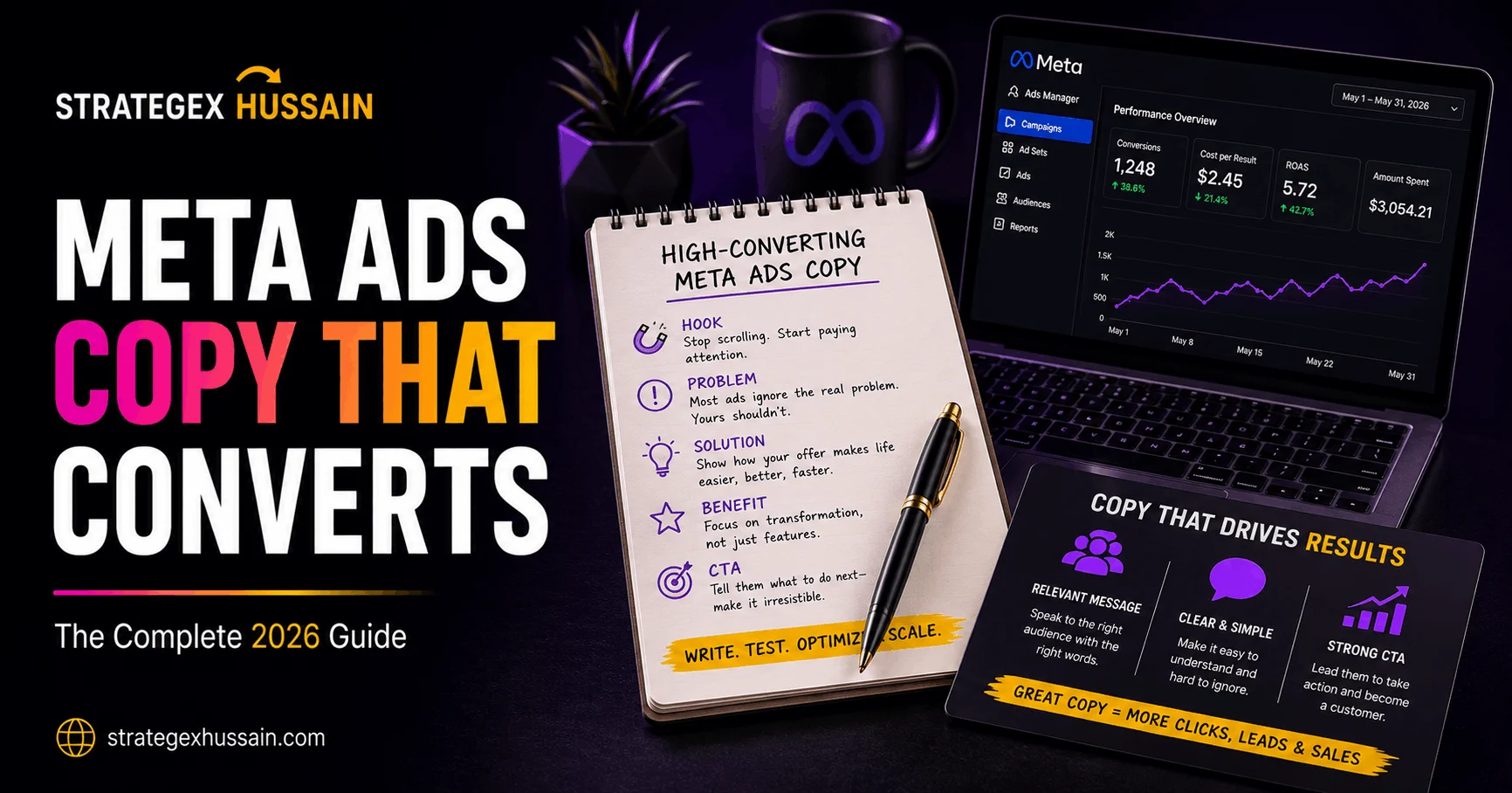
Bad copy kills good campaigns. Strong copy rescues bad ones. And knowing how to write Meta Ads copy that actually connects with your audience, stops the scroll, and moves people from passive scrolling to active buying is the single highest leverage skill in ecommerce marketing today.
This is the complete guide. By the end you will know exactly how to write every element of a Meta Ad from the hook to the headline to the call to action, for every type of campaign and every stage of the funnel.
Why Most Meta Ads Copy Fails Before Anyone Reads It
Before we get into how to write great copy, you need to understand why most copy fails. Because the mistakes are consistent and once you see them you cannot unsee them in your own ads.
The first and most common failure is writing copy that talks about the product instead of talking to the customer. “Our moisturizer is made with 12 natural ingredients and has a lightweight formula.” Nobody cares. What they care about is: “Wake up to skin that actually glows without caking on three layers of makeup first.” Same product. Completely different approach. One talks about features. One talks about the customer’s life.
The second failure is leading with a weak or nonexistent hook. On Instagram and Facebook, your ad competes with content from every person your customer follows, every brand they have interacted with, and every other advertiser targeting the same audience. If the first line of your copy does not immediately grab attention, the rest does not matter. People scroll. Your money disappears.
The third failure is writing copy that sounds like an advertisement. Customers have developed an extraordinary sensitivity to promotional language. Words and phrases that scream “this is an ad” trigger instant skepticism and resistance. The copy that converts in 2026 sounds like it was written by a human being who genuinely understands the customer’s situation, not by a marketing team trying to hit conversion targets.
Understanding these three failures is the foundation of learning how to write Meta Ads copy that actually works.
The Anatomy of a Meta Ad: Every Element You Need to Master
A Meta Ad has several distinct copy elements and each one has a specific job to do. Most brands treat them as an afterthought. The brands that are winning on Meta treat each element as a precision tool.
The Primary Text
This is the copy that appears above your image or video in the feed. On mobile it shows the first 125 characters before being cut off by a “see more” link. This means your first line needs to work as a standalone hook that compels the reader to tap “see more” or engage with the ad immediately.
The primary text is where you tell the story. Where you address the pain. Where you build desire. Where you make the case for your product. It can be one line or several paragraphs depending on your campaign objective and audience temperature. Cold audiences generally need more context. Warm retargeting audiences need less because they already know your brand.
The Headline
The headline appears below your image or video, just above the call to action button. It is often the last thing someone reads before they decide to click or scroll past. Its job is to deliver the clearest, most compelling statement about your offer or your product’s primary benefit. Keep it under 40 characters so it does not get truncated on mobile.
The Description
The description appears below the headline in some ad placements. It is a secondary line of copy that reinforces the headline or adds a specific detail like pricing, a key feature, or a time sensitive element. Not all placements show the description so treat it as a bonus rather than a primary copy element.
The Call to Action Button
Meta gives you a set of predefined call to action buttons. For ecommerce the most commonly used are Shop Now, Learn More, and Get Offer. Your choice of CTA button should match the temperature of your audience. Cold audiences respond better to Learn More because it feels lower commitment. Warm audiences and retargeting audiences respond better to Shop Now because they are already familiar with your brand and closer to purchasing.
The Hook: The Most Important Line You Will Ever Write
If there is one element of Meta Ads copy that determines success or failure more than any other it is the hook. The first line. The opening sentence. The thing your customer reads before they decide whether to keep reading or keep scrolling.
A great hook does one of five things. It calls out the specific person the ad is for. It makes a bold or counterintuitive claim. It opens a loop that creates curiosity. It speaks directly to a pain point the customer is currently experiencing. Or it leads with a surprising or compelling fact.
Here is what each approach looks like in practice for an ecommerce brand.
The Callout Hook
This hook directly addresses the specific person you are targeting. It creates an immediate “this is for me” moment that stops the scroll.
“Pakistani women with oily skin, this one is for you.”
“If you are running an ecommerce store and your Meta Ads are not profitable, read this.”
“Attention: new moms who have not slept properly in months.”
The callout hook works because it eliminates irrelevance immediately. The people it is targeting feel seen. The people it is not targeting scroll past. And that is fine. You only want the right people stopping.
The Bold Claim Hook
This hook makes a statement that challenges what the customer currently believes or expects. It creates cognitive dissonance that demands resolution.
“Most skincare routines are making your skin worse, not better.”
“Your Meta Ads are failing because of your copy, not your targeting.”
“The reason your jewelry is not selling has nothing to do with the product.”
Bold claim hooks perform best when the claim is genuinely surprising and when the rest of the copy delivers on the promise of explaining why the claim is true. Do not make a bold claim and then fail to back it up. You will lose trust instantly.
The Open Loop Hook
This hook creates a question or scenario that the customer’s brain needs to resolve. It triggers the psychological principle of open loops, where an unfinished thought demands completion.
“We tried 14 different moisturizers before finding the one that actually worked. Here is what we learned.”
“She ordered our serum as a last resort. This is what happened in 30 days.”
“Everyone told her it would not work. She tried it anyway.”
Open loop hooks are particularly effective for video ads because they create a compelling reason to keep watching. But they work in text format too. The customer has to keep reading to resolve the story you started.
The Pain Point Hook
This hook speaks directly to a frustration, problem, or challenge that your target customer is currently experiencing. It works because it creates an instant feeling of being understood.
“Tired of spending on skincare products that promise everything and deliver nothing?”
“You post every day. Your engagement is still flat. And you have no idea why.”
“Your skin looks fine in the bathroom mirror. Terrible in photos. Sound familiar?”
Pain point hooks convert exceptionally well for cold audiences because they meet the customer in their current emotional state rather than trying to create a new one. The customer feels understood before they have even read the rest of the ad.
The Surprising Fact Hook
This hook leads with a statistic, fact, or piece of information that the customer did not know and finds genuinely interesting or alarming.
“The average woman applies over 168 chemicals to her skin before leaving the house in the morning.”
“87 percent of ecommerce brands that run Meta Ads are not profitable. Here is what the other 13 percent do differently.”
“Your sunscreen is only effective for two hours. Most people apply it once and think they are protected all day.”
Surprising fact hooks work because they establish authority and create curiosity simultaneously. If you know something surprising that I do not, I want to hear what else you know.
Writing the Body Copy: Building Desire and Making the Case
Once your hook has stopped the scroll, your body copy has one job: build enough desire and trust that the customer takes the action you want them to take. Here is how to do it.
The PAS Framework: Problem, Agitate, Solution
PAS is the most reliable copywriting framework for Meta Ads cold traffic and it works because it mirrors the emotional journey a customer needs to go through before buying.
Problem: State the problem your customer has in their own language. Not your language. Theirs. The way they would describe it to a friend. “You spend every morning applying three different products to your face and by noon your skin looks exactly the same as when you started.”
Agitate: Deepen the problem. Make the customer feel the weight of it. Not in a manipulative way but in a way that makes them recognize how much it is costing them. “Meanwhile you are spending thousands of rupees a year on products that sit half-used in your bathroom cabinet while your skin still does not look the way you want it to.”
Solution: Present your product as the specific answer to the specific problem you just made them feel. “That is exactly why we formulated [Product Name]. One serum. Morning and night. Visible difference in 14 days or your money back.”
PAS works because it creates emotional investment before making the offer. By the time you present your solution the customer is already primed to receive it positively.
The DIC Framework: Disrupt, Intrigue, Click
DIC is a shorter, punchier framework that works especially well for mobile placements where you have limited space and limited attention.
Disrupt: Your hook disrupts the scroll. Bold visual or bold first line.
Intrigue: Build curiosity about what you are offering without revealing everything. “There is a reason our serum has 4,700 five star reviews and a waiting list of 3,000 people.”
Click: Give them a reason to click right now. “Tap Shop Now before we sell out again.”
DIC is particularly effective for retargeting campaigns where the customer already knows your brand and does not need a full explanation of who you are or what you sell. They just need a compelling reason to act now.
The AIDA Framework: Attention, Interest, Desire, Action
AIDA is the classic marketing framework and it works as well in Meta Ads as it has in every other format for the last hundred years.
Attention: Your hook grabs it.
Interest: Relevant information that keeps them reading. “Our body butter is made with 100 percent natural shea and cold pressed argan oil. No parabens. No sulphates. Nothing your skin does not need.”
Desire: Paint the picture of their life with your product in it. “Imagine stepping out of the shower and your skin already feeling soft, hydrated, and genuinely taken care of. Without a 10 step routine. Without spending a fortune.”
Action: A clear, specific instruction. “Tap Shop Now and get yours delivered in 3 to 5 days.”
AIDA works for longer form copy targeting cold audiences who need more context and persuasion before they are ready to buy.
Writing Copy for Every Stage of the Funnel
One of the biggest mistakes brands make when learning how to write Meta Ads copy is using the same copy for every audience. Cold traffic, warm traffic, and retargeting audiences are at completely different stages of the buying journey. They need completely different copy.
Cold Audience Copy: Strangers Who Have Never Heard of You
Cold audiences do not know your brand, do not trust you, and have no particular reason to care what you are selling. Your copy needs to earn their attention from zero.
For cold audiences lead with the pain point or the hook that speaks to a universal frustration in your target market. Spend more time on the problem than you think is necessary. Do not assume they understand why your product is relevant to their life. Show them. Build context before you make any offer.
Avoid heavy promotional language with cold audiences. Words like “sale,” “discount,” and “limited time” lose effectiveness when the customer does not yet trust your brand. Focus on building interest and desire first. Save the offer for the middle or end of the copy rather than leading with it.
Example cold audience copy for a skincare brand: “Nobody talks about how much money Pakistani women waste on skincare products that do not actually work for our skin type. Most products on the market are formulated for Western skin tones and climates. They do not account for our humidity levels, our skin’s natural undertones, or the specific environmental stressors we face every day. That is why we built [Brand Name] differently. Formulated specifically for South Asian skin. Tested by real women in Karachi, Lahore, and Islamabad. And guaranteed to show visible results in 14 days. Tap to learn more.”
Warm Audience Copy: People Who Know You But Have Not Bought
Warm audiences have seen your content, visited your website, or engaged with your previous ads. They are familiar with your brand. Your copy does not need to start from zero. It needs to move them from consideration to decision.
For warm audiences focus on what is stopping them from buying. Common objections at this stage are price, uncertainty about whether the product will work for them specifically, and lack of urgency. Your copy should address these directly.
Social proof is especially powerful for warm audiences. Testimonials, review counts, and specific customer results give the hesitant buyer the confirmation they need. “Over 2,400 women have already switched to [Product Name]. Here is what they are saying.”
Create urgency without being desperate. “We restock every 3 to 4 weeks and we consistently sell out before the next batch arrives” is more credible and more effective than “SALE ENDS TONIGHT!!!” which triggers skepticism.
Retargeting Copy: People Who Almost Bought
Retargeting audiences are the warmest traffic you have. They visited your product page. They added to cart. They spent time reading your product descriptions. They were interested enough to take action, just not the final action of purchasing.
Retargeting copy should be short, direct, and specific. These people do not need to be sold on your brand. They need one more push. Address the most likely reason they did not complete the purchase.
If price is the most common objection, lead with your guarantee or your value proposition. “Still thinking about it? We offer free returns within 14 days. Zero risk.” If uncertainty about results is the objection, lead with social proof. “Over 3,000 orders shipped. Here is why people keep coming back.”
Abandoned cart retargeting copy can be extremely direct: “You left something behind. Your [Product Name] is still available. Tap to complete your order before it sells out.” Simple. Personal. Effective.
The Language of Conversion: Words That Sell and Words That Kill
The specific words you choose in your Meta Ads copy have a direct impact on conversion rates. Some words build trust and desire. Others trigger skepticism and resistance. Here is what you need to know.
Words and Phrases That Convert
You and Your. Copy written in second person, speaking directly to one person, always outperforms copy written about a product in third person. Every sentence should feel like it was written for one specific individual.
Because. People are more likely to comply with a request when a reason is given. “Tap Shop Now because we only restock once a month and this batch is almost gone” converts better than “Tap Shop Now.”
Imagine. This word invites the customer to mentally simulate having your product. Once someone has imagined a positive experience with your product, the desire to make that experience real increases dramatically.
Proven, Guaranteed, Results. These words reduce perceived risk, which is one of the primary barriers to purchase for first-time buyers. Use them only when you can back them up with specifics.
Specific numbers. “4,700 five star reviews” converts better than “thousands of happy customers.” “Visible results in 14 days” converts better than “results in a few weeks.” Specificity signals honesty. Vague claims signal exaggeration.
Words and Phrases That Kill Conversions
Revolutionary, Game-changing, World-class. These are marketing words that nobody believes anymore. They trigger immediate skepticism because every mediocre product claims to be revolutionary. Use them and you lose credibility before you make your case.
Best ever, Number one, Top-rated. Unless you can back these up with a specific source, these claims feel hollow and promotional. Remove them from your copy entirely.
Click here. This phrase has become associated with spam and low-quality advertising. Use action-specific language instead. “Tap to shop,” “Discover your shade,” “Get yours now.”
We, Our, Us. Copy that talks about your brand more than it talks about the customer is copy that does not convert. Every time you write “we” ask yourself whether you can reframe that sentence to make it about the customer instead.
Cheap, Affordable, Low price. These words attract price-sensitive buyers who are less likely to become loyal customers. If you want to mention price do it in terms of value, not cheapness. “Premium quality at a price that makes sense” lands differently than “cheap skincare.”
Writing Copy for Different Ad Formats
The platform gives you multiple ad formats and each one requires a slightly different copy approach. Here is how to write for each.
Single Image Ads
Single image ads are the most common format and they require the tightest copy. You have one image doing the visual work and limited copy space to make your case. Lead with your strongest hook. Keep the body copy concise and focused on one clear benefit. End with a direct call to action.
The headline below the image is critical for single image ads. It should deliver your clearest benefit statement or your strongest offer. “Glow in 14 days or your money back.” “Free delivery across Pakistan.” “Finally, skincare that actually works for our skin.”
Video Ads
For video ads your primary text copy supports the video rather than doing all the selling itself. Keep your primary text to one or two lines that complement the video hook. Let the video carry the narrative. Use the primary text to add context or urgency that the video does not cover.
The first three seconds of the video are your real hook. Make sure your video script leads with the strongest visual and the most compelling statement before someone scrolls past. Your written copy and video hook should work together, not repeat each other.
Carousel Ads
Carousel ads give you multiple cards to tell a story. Your primary text introduces the story. Each card headline tells one chapter of it. The final card delivers the offer and call to action.
Write each card headline as if it stands alone because some people will not swipe through every card. Each headline should be compelling enough that someone who only reads that one card still gets value and still has a reason to click.
Story Ads
Story ads appear full screen in the Stories format. Copy should be minimal because the visual is doing most of the work. Lead with a strong visual hook. Keep any text overlay to a single punchy line. Use the swipe up or tap action to move people to the next step.
Stories move fast. Your audience is swiping through Stories quickly. You have less than 3 seconds to stop them. Make your visual and your copy line count immediately.
Social Proof Copy: The Most Persuasive Copy You Will Ever Write
The most powerful copy in your Meta Ads is often not copy you write yourself. It is words your customers have already said about your products. Social proof copy, whether customer testimonials, review excerpts, or case study results, consistently outperforms brand-created copy because it carries the weight of independent validation.
Here is how to use social proof effectively in your Meta Ads copy.
Leading With a Customer Quote
Opening your primary text with a customer quote flips the dynamic of the ad immediately. Instead of a brand making claims about itself, a real customer is making claims about their real experience.
“I have tried every moisturizer on the market. Nothing worked. Then I found [Product Name]. My skin cleared up in 3 weeks. I am never going back.” — Fatima, Karachi
This approach works because it bypasses skepticism. The customer is not reading a brand claim. They are reading someone else’s experience and deciding whether it sounds like their situation too.
Review Count as Social Proof Copy
Large review counts function as social proof even without specific quotes. “Join 8,400 women who have already made the switch” communicates that many people have validated this product with their own purchasing decision. This reduces the perceived risk for someone considering buying for the first time.
Specific Result Claims
Specific customer results are more persuasive than general satisfaction statements. “Customers report a 73 percent reduction in visible pores after 30 days” is more compelling than “customers love our product.” The specificity signals that the claim is based on real data rather than marketing optimism.
Writing Copy That Does Not Sound Like AI or a Marketing Template
This deserves its own section because it is one of the most important and most undervalued skills in Meta Ads copy today.
Customers in 2026 have been exposed to so much AI-generated and template-driven marketing content that they have developed an instinctive sensitivity to it. Copy that reads like it was generated by a formula gets ignored or dismissed before the first line is finished.
The copy that converts reads like it was written by a real human being who genuinely understands the customer’s life. It has rhythm. It has personality. It has specific details that only someone who truly knows the customer would include.
Here is how to write copy that feels human.
Write the way your customer talks. Before you write a single word of ad copy, write down three ways your ideal customer would describe their problem to a friend. Use that language in your copy. Not marketing language. Their language.
Include specific, unexpected details. Generic copy says “our moisturizer will make your skin feel soft.” Human copy says “the kind of soft where you genuinely forget to put on lotion because your skin already feels like you did.” That specific detail signals that you actually know what good skin feels like. It builds trust.
Read your copy out loud. If it sounds like something a person would say in a real conversation, it passes. If it sounds like something a brand would put on a billboard, rewrite it.
Avoid symmetry and perfect structure. Real human communication is slightly imperfect. It has varied sentence lengths. Short punchy sentences followed by longer more detailed ones. Fragments that work because of their rhythm. Perfectly formatted copy with bullet points and equal length sentences reads like a template. Break the pattern.
The Testing Framework: How to Know If Your Copy Is Actually Working
Writing great copy is a skill that develops through testing, not through theory. Here is the framework for testing your Meta Ads copy systematically so you improve with every campaign.
Test One Variable at a Time
The most common testing mistake is changing too many elements simultaneously. When your results change you have no idea which change caused it. Test one copy element at a time. Start with the hook since it has the biggest impact on overall performance. Run two versions of the same ad with different hooks. Keep everything else identical. Let each version run for at least 7 days before drawing conclusions.
Metrics to Watch for Copy Performance
Thumb stop rate or hook rate. What percentage of people who see your ad stop scrolling to engage with it? This measures the effectiveness of your hook directly. A strong hook produces a high thumb stop rate. If this number is low your hook is not working regardless of how good your body copy is.
Click through rate. What percentage of people who see your ad click through to your website or product page? Low CTR with a high thumb stop rate means your hook works but your body copy or headline is not compelling enough to drive action.
Cost per purchase. The ultimate measure of copy effectiveness for ecommerce. If your copy is doing its job the cost per purchase should decrease over time as you find the messages and frameworks that resonate most with your audience.
The Copy Testing Calendar
Month 1: Test 3 different hooks on your best performing creative. Identify the winner.
Month 2: Test 3 different body copy frameworks using the winning hook. PAS vs DIC vs AIDA. Identify the winner.
Month 3: Test 3 different calls to action and headline combinations with the winning hook and framework combination.
By month 3 you will have a copy combination that has been tested and proven across every major element. That combination becomes your control. Everything you test in future months is measured against it.
Real Examples: Meta Ads Copy That Converts for Ecommerce Brands
Theory only takes you so far. Here are complete copy examples for different ecommerce scenarios so you can see exactly how all these principles work together in practice.
Cold Traffic Skincare Ad
Primary Text:
Pakistani summers are brutal on skin. The heat, the humidity, the pollution. And most of the skincare products we are sold are formulated for climates that are nothing like ours.
That is why our customers kept coming back to the same complaint: everything they tried either made their skin oily by noon or dried it out completely by evening.
So we built something different. [Product Name] is a lightweight serum formulated specifically for South Asian skin in a humid climate. No heavy textures. No ingredients that react badly to heat. Just clean hydration that lasts all day.
4,200 five star reviews. Free delivery across Pakistan. 14 day money back guarantee.
Tap Shop Now to try yours.
Headline: Skincare built for our climate.
Warm Audience Jewelry Ad
Primary Text:
You have seen our pieces. You know what we do.
Here is what you might not know: every piece in our Eid collection is handcrafted individually. No two are exactly the same. And once a design sells out we do not restock it.
We have 11 pieces left in the collection you were looking at.
Tap Shop Now before someone else gets yours.
Headline: Handcrafted. Limited. Yours.
Retargeting Abandoned Cart Ad
Primary Text:
Still thinking about it?
Your [Product Name] is still available. But we sell out faster than we restock and once this batch is gone the next one is 3 weeks away.
Free delivery. Easy returns. 4,700 people already wearing theirs.
Tap to complete your order.
Headline: Your order is waiting.
Frequently Asked Questions About How to Write Meta Ads Copy
How long should Meta Ads copy be?
It depends on your audience temperature and your campaign objective. For cold audiences longer copy of 100 to 200 words in the primary text often outperforms shorter copy because cold audiences need more context and persuasion. For warm audiences and retargeting campaigns shorter copy of 30 to 80 words tends to perform better because the audience already knows your brand. Test both with your specific audience to find what works.
Should I use emojis in Meta Ads copy?
Used strategically, emojis can improve copy performance by breaking up text, adding visual interest, and making copy feel more conversational and human. Used excessively they make copy look unprofessional and spammy. One or two emojis used to highlight key points or as bullet alternatives can work well. Avoid using them in every line or using multiple emojis in a row.
How do I write Meta Ads copy for a product people have never heard of?
Lead with the problem, not the product. If your product is new to market, your audience does not yet have the context to understand why they need it. Start by making them feel the pain point your product solves. Build the problem in detail. Then introduce your product as the specific answer to the specific problem you just made them feel. The product becomes the solution to their problem rather than an unknown thing you are trying to sell them.
What is the most important element of Meta Ads copy?
The hook. The first line. The opening statement that determines whether anyone reads anything else. More campaigns fail because of weak hooks than for any other copy reason. Spend at least as much time on your first line as you spend on everything else combined. Test multiple hooks. Identify the one that generates the highest thumb stop rate and build the rest of your copy around it.
How do I write copy that does not get flagged by Meta?
Avoid making before and after claims in health and beauty ads as Meta restricts these. Do not use language that implies Meta users have a personal characteristic, for example “you have oily skin” rather than “for people with oily skin.” Avoid exaggerated income or result claims. Do not use countdown timers or scarcity language that is not genuine. Keep copy honest, specific, and benefit-focused and you will rarely have issues with Meta’s ad policies.
How often should I refresh my Meta Ads copy?
When your frequency score in Ads Manager rises above 2.5 to 3 for a specific audience, your copy and creative are experiencing fatigue and performance will start declining. At that point refresh your copy with new hooks, new angles, or new social proof. For evergreen campaigns running to broad audiences you may be able to run the same copy for several months. For smaller retargeting audiences copy can fatigue in as little as two to three weeks.
The Bottom Line: Copy Is the Lever That Moves Everything Else
You can have the best targeting on the platform. The highest quality creative. The biggest budget. And still fail completely if your copy does not connect with your audience.
Learning how to write Meta Ads copy that actually converts is not about memorizing formulas or following templates. It is about understanding your customer so deeply that your copy feels like it was written specifically for them. It is about choosing every word with intention. It is about testing relentlessly and letting data tell you what works.
The brands that master this skill do not just run better ads. They build a compounding advantage that gets stronger with every campaign because they know more about what their audience responds to than any competitor who is guessing.
Start with the hook. Make it impossible to scroll past. Build the body copy around the framework that matches your audience temperature. End with a clear, specific call to action. Test one variable at a time. Document everything. Improve with every campaign.
That is how you build a Meta Ads copy system that does not just generate sales today. It generates better sales every month for as long as you run it.
You can also read our posts on why most ecommerce brands waste money on Meta Ads and Meta Ads vs Google Ads for ecommerce to build a complete paid advertising strategy around your copy system.
Want high-converting Meta Ads copy written specifically for your ecommerce brand? We research your audience, write the copy, and manage the campaigns. Get a Free Proposal here.